Advisor Development Service
Empowering advisors to better serve their clients.
Launched on
Visit →
Overview
Northwestern Mutual’s mission is to free Americans from financial anxiety so they can live the life they want — today and tomorrow. Achieving that depends heavily on advisor quality and continuous development.

As Lead Product Designer across the Practice Management product area, I led design strategy in partnership with 5 cross-functional design pods — comprising designers, content strategists, and UX researchers — and collaborated with product managers, directors, and business analysts to drive this initiative from discovery through delivery.
Early advisors navigate six separate platforms for required lessons, product qualifications, language practice, and continuing education — all while hitting production targets. Learning is often seen as a distraction, yet it’s directly tied to long-term success. Engagement remained low and NM had no reliable way to reach advisors who were falling behind.
Approach
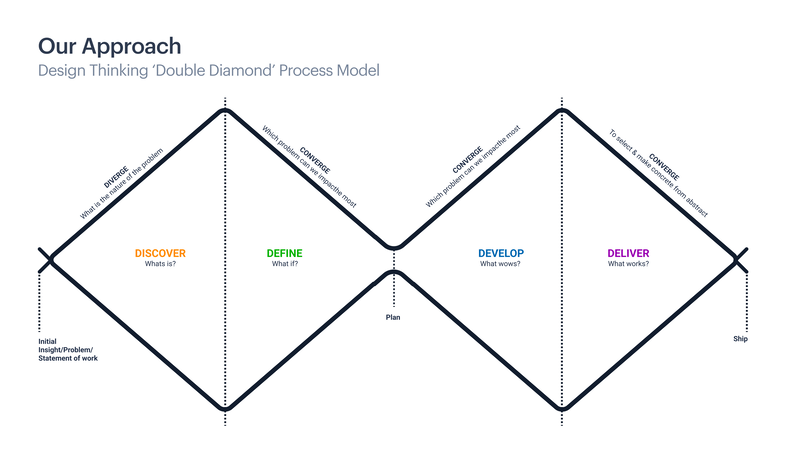
We used a double diamond framework across four phases: Understand, Define, Sketch, and Converge. The team built a shared knowledge base from existing research, vendor exploration, and usage data before any design work began.
Define
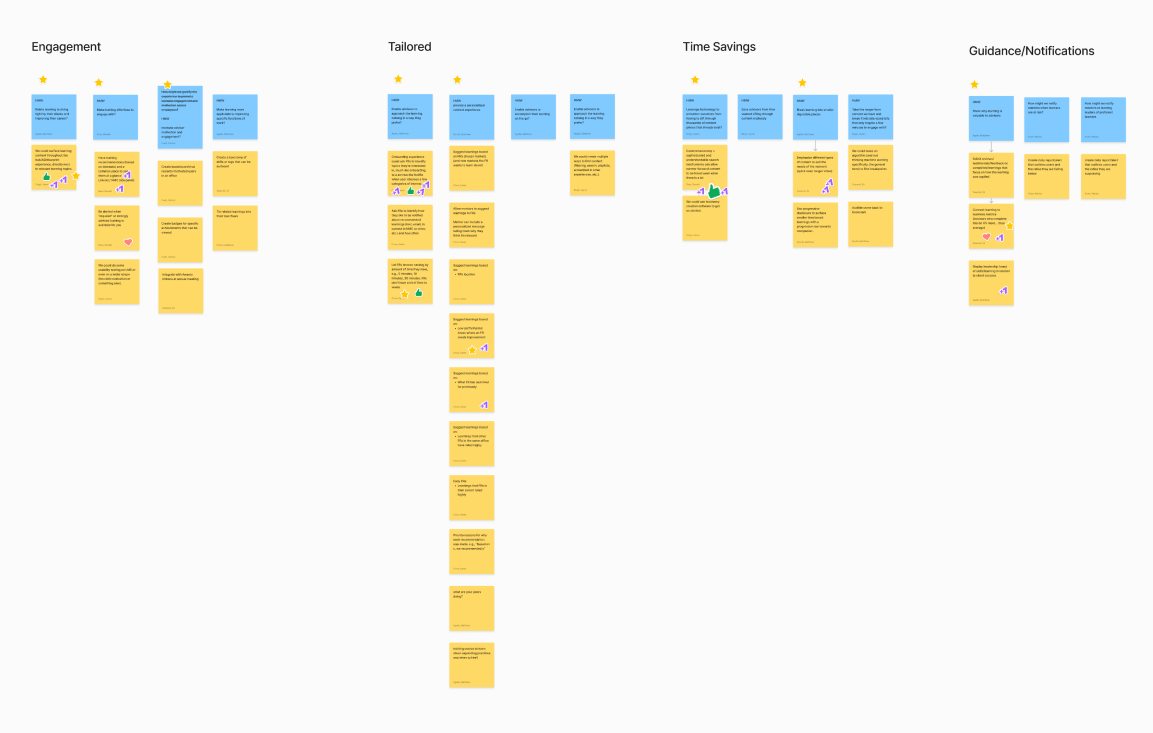
Affinity mapping surfaced four major opportunity themes: Engagement, Tailored experiences, Time Savings, and Guidance/Notifications.
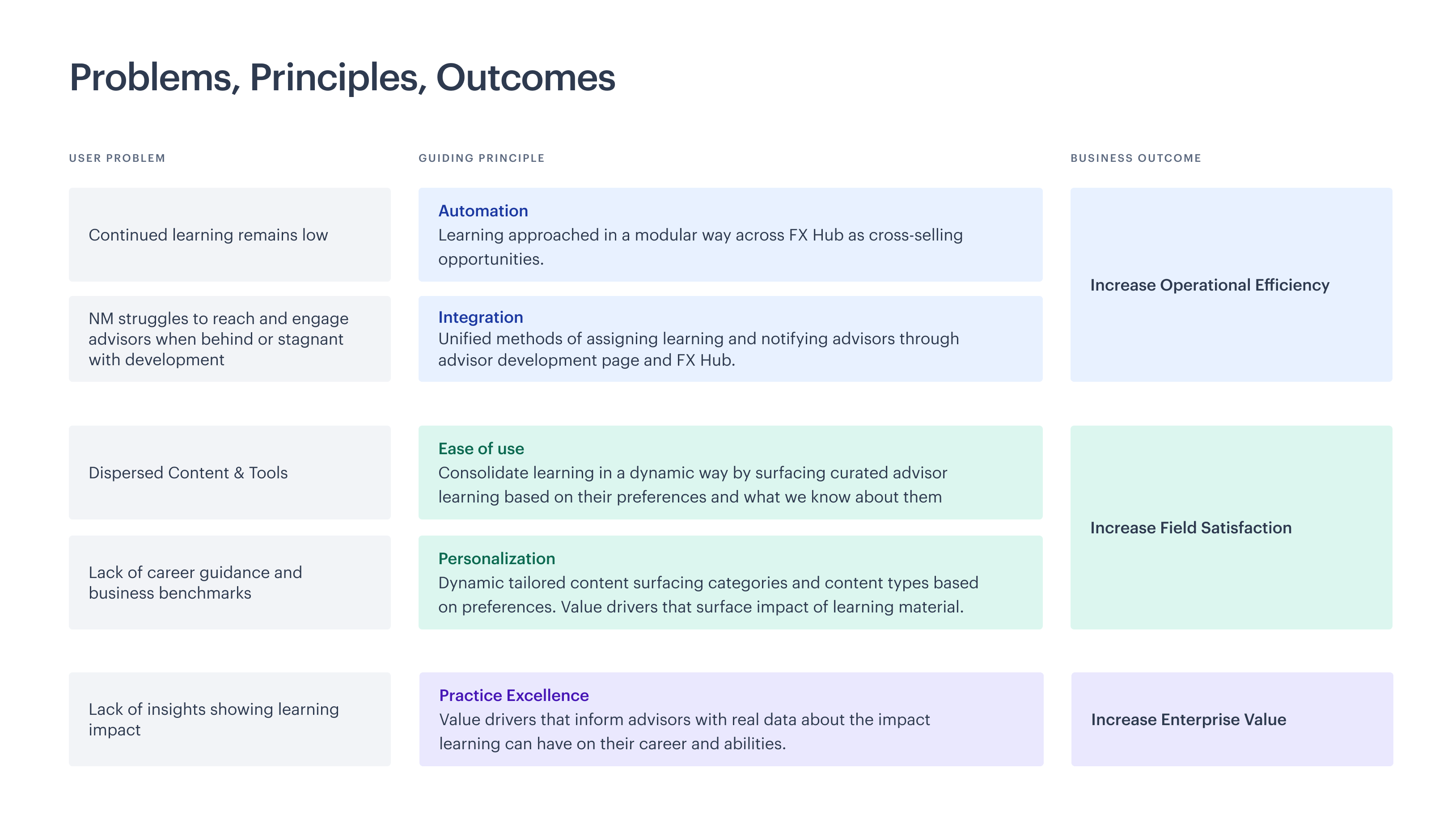
From there, we mapped each user problem to a guiding principle and a measurable business outcome — keeping the team aligned on what we were solving and why.
Sketch
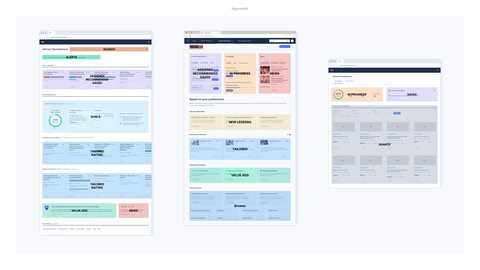
Three concepts were developed independently before converging on a direction — covering a cards-based layout, an FX Hub integration model, and a search-and-filter approach.
Proof of Concept
I facilitated a Google Design Sprint workshop with executive and cross-functional stakeholders to drive alignment on problem definition, opportunity identification, and feature prioritization — using cost-benefit analysis to inform MVP scope before any engineering commitment was made.
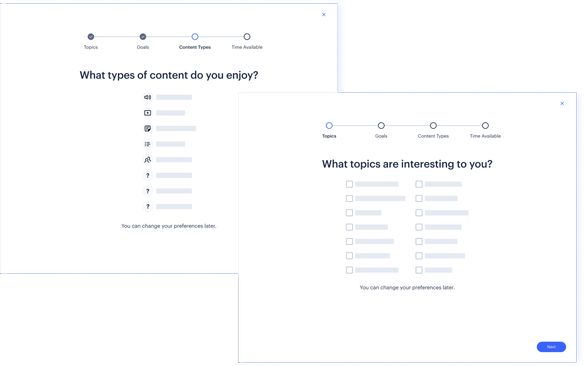
Before committing to a full build, we created onboarding screens to test how advisors expected to personalize their experience — gathering early signal on preferences for content type, topics, and format.
Research & Refinement
Three high-fidelity concepts were tested in Round 2. Advisors consistently valued structured guidance — knowing what to focus on first — paired with the freedom to browse and search on their own terms.
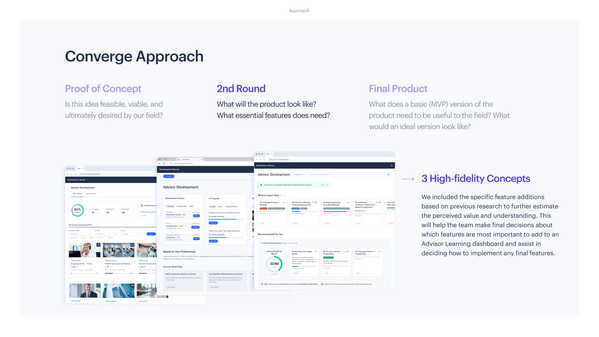
Key findings: personalized recommendations driven by production data, role, and tenure were the highest-valued feature. Impact metrics showing how similar learnings affected other advisors significantly increased motivation to engage.
Final Design
The final experience consolidates learning into a single destination with a “What to Learn Now” queue, personalized recommendations, and clear progress indicators — surfacing the right content at the right time without requiring advisors to go looking for it. The MVP was handed off across 4 engineering teams, with success measured via HEAP analytics in partnership with UX Research.